
Wealth Management News & Insights
Brazilian Markets Crash, Public College Prices Increasing, Mild Chicago Winter
Primary Sources
- U.S. Import and Export Price Indexes Summary: U.S. import and export prices rose sharply in September 2026, driven by higher fuel, commodity, and goods costs, with import prices up 1.1% and export prices up 2.2% from the previous month. [U.S. Bureau of Labor Statistics]
- U.S. Securities and Exchange Commission: Anthropic, PBC: Anthropic, PBC’s S-1 filing details its planned IPO while highlighting explosive AI-driven growth, with first-half 2026 revenue rising to about $16.3 billion, alongside significant infrastructure investments and governance structures designed to maintain long-term founder and mission control. [SEC]
- Federal Reserve Issues FOMC Statement: The Federal Reserve left interest rates unchanged at 3.75% to 4.0%, citing strong economic growth and resilient consumer spending while signaling it needs more data before taking further action to bring inflation back to its 2% target. [FRB]
- GDP (Advance Estimate), 3rd Quarter 2026: Investment and consumer spending fueled stronger economic activity in the third quarter, while easing inflation pressures provided additional support. [BEA]
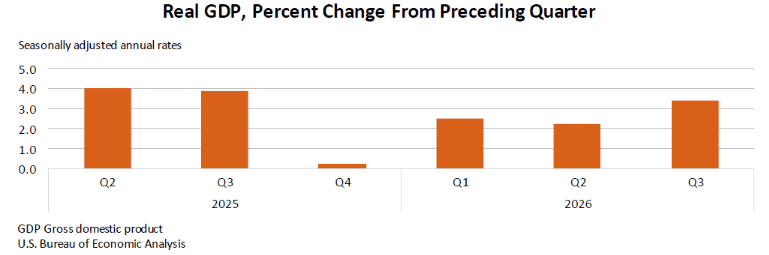
U.S. economic growth accelerated to 3.4% in Q3 2026, rebounding from weaker growth earlier in the year.
Financial Markets
- Vertiv Earnings Set a New Bar for AI Stocks: Big Tech giants Alphabet and Microsoft are likely to grab investors’ attention on Wednesday, but Vertiv Holdings just showed there’s more than one way to play the artificial intelligence boom. [Barron’s]
- Brazilian Markets Crash After Lula’s Surprise Election Win Stuns Investors: Brazilian financial assets suffered a historic rout after leftist leader Luiz Inácio Lula da Silva won the presidential election. [WSJ]
- Anthropic’s I.P.O. Prospectus Spells Out a Future of Promise and Peril: The A.I. company took great pains to describe the many benefits that can come from using its Claude chatbot and technology but also offered up a heavy dose of gloom. [NYT]
Financial Planning
- Public Colleges Are Passing the $50,000-a-Year Mark. For Locals: At the University of California campuses in Berkeley, Irvine and Santa Barbara, students get an unwitting education in navigating the housing market. [NYT]
- Over 40% of Americans Don’t Know How Much They’ll Need for Retirement: Many Americans are delaying retirement planning due to financial uncertainty, rising costs, and confusion about where to start, increasing the risk of falling behind on long-term savings goals. [Yahoo! Finance]
Business Strategy
- How Aldi is Pushing Down Grocery Prices: Aldi is reshaping the grocery industry by using a stripped-down, efficiency-focused business model that enables it to match or beat competitors on price, forcing other retailers to lower prices as well. [NPR]
- Microsoft Offers a Quarter of its Global Workforce Voluntary Buyouts as AI Spending Accelerates: As Microsoft ramps up spending on artificial intelligence, the company is giving eligible employees an opportunity to leave with incentives as part of a broader effort to realign resources and priorities. [AP News]
Life & Work
- NASA Says Artemis Program Adjustments Improve Shot at 2028 Moon Landing: NASA has revised its Artemis program to keep both SpaceX and Blue Origin moon lander options open, aiming to improve the odds of returning astronauts to the lunar surface by 2028 despite technical and scheduling challenges. [CBS News]
- New Maps Reveal Who Could See More Snow During this Year’s Super El Niño: This year’s potentially record-setting El Niño is expected to shape winter weather and snowfall across the US. A new CNN Weather analysis shows how snowfall has changed during El Niño winters, offering clues as to what to expect this season. [CNN]
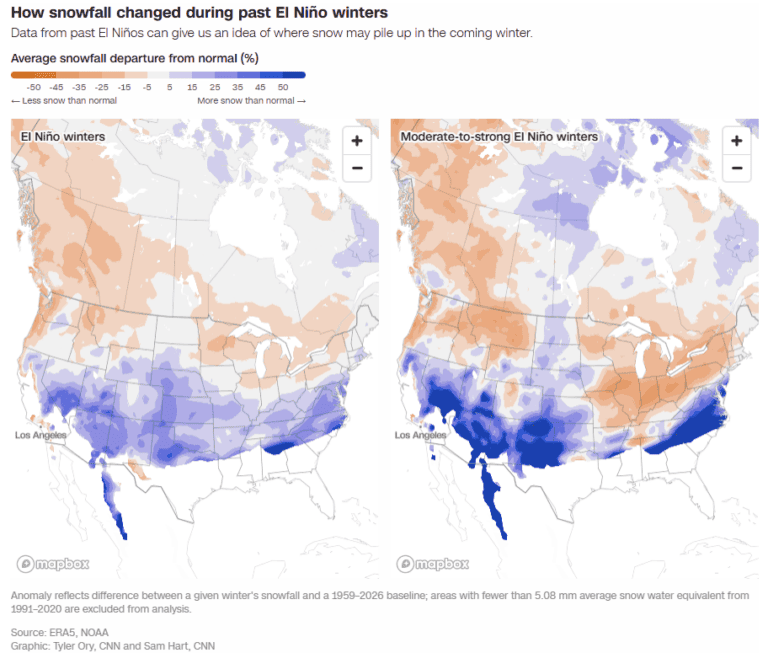
Past El Niño winters have generally brought above-normal snowfall across the southern U.S., with stronger El Niño events producing the largest increases from California to the Southeast while much of the northern U.S. saw below-average snowfall.