
Wealth Management News & Insights
Honeywell Aerospace Approved, SpaceX Leaves California, Guide to a Better Retirement Plan

Primary Sources
- Transcript of Chairman Warsh’s Press Conference Opening Statement June 17, 2026: The Federal Reserve’s press conference outlines the latest FOMC decision, explaining the current stance on interest rates, inflation, and economic conditions, while providing forward guidance on monetary policy. It emphasizes the Fed’s ongoing effort to balance inflation control with sustaining economic growth. [Federal Reserve Board]
- Honeywell Board of Directors Approves Spin-Off of Honeywell Aerospace: Honeywell announced that its board has approved the spin-off of its aerospace division, creating two separate companies focused on aerospace and industrial automation, with the move aimed at sharpening strategic focus and driving long-term shareholder value. [Honeywell]
Financial Markets
- SpaceX Left California. Its IPO Payday Did Not: The company’s June 12 IPO, valuing it at around $1.8 trillion, should boost tax revenue in the Golden State because thousands of newly wealthy employees who live and work there face a “millionaires” tax. Meanwhile, Texas doesn’t tax personal income at all. [Forbes]
- Washington: What to Watch Now: Kevin Warsh leads his first FOMC meeting, affordable housing bill poised to pass Congress, and Trump’s BLS head nominee vows to protect independence of government economic data. [Charles Schwab]
- Alphabet, Google’s Parent, Is Joining the Dow: Alphabet is being added to the Dow Jones Industrial Average, marking a shift in the index’s composition and reflecting the growing influence of major technology companies in U.S. equity markets. [WSJ]
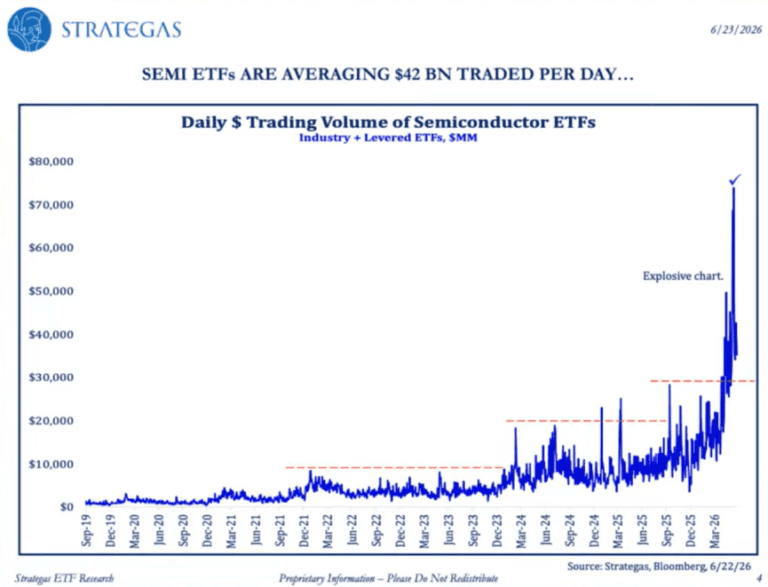
Daily trading volume across semiconductor ETFs — spanning both industry-specific and leveraged products — has surged to an average of $42 billion per day, underscoring the intense investor appetite driving the industry’s continued outperformance this year.
Financial Planning
- How to Build a Better Retirement-Spending Plan Than the 4% Rule: The 4% rule has some blind spots. It assumes a 30-year retirement, but some retirees will need their money to last longer than that. As a result, researchers have been lowering or raising the figure. If you withdraw a certain percentage of your assets based on life expectancy, plus some tweaks, you can avoid some of the drawbacks. [WSJ]
- 5 Countries Wealthy People Are Moving to — and What They’re Looking For: The countries attracting wealthy residents reveal what many affluent households value most: opportunity, stability and quality of life. [Kiplinger]
Business Strategy
- Those World Cup “Hydration Breaks” Have Fox Rolling in Dough: World Cup hydration breaks have become a major revenue opportunity for Fox, creating new in-game advertising slots that could generate hundreds of millions of dollars, even as the approach draws viewer criticism for interrupting play. [The Hollywood Reporter]
- Meta Announces New Smart Glasses Starting at $299, as Zuckerberg Keeps Pushing Wearables: Meta unveiled new smart glasses starting at $299 as part of its push to dominate AI-driven wearable hardware, aiming to expand adoption with lower prices while competing against growing rivals like Google and Snap. [CNBC]
Life & Work
- The NFL Rejects the Quarterback at the Heart of College Football’s Gambling Storm: After his gambling scandal plunged college sports into turmoil, Texas Tech quarterback Brendan Sorsby believed he would find a soft landing in the NFL. He abandoned his litigation against the NCAA after the organization banned him for placing thousands of bets, including some on his own team, and thought he could simply turn pro. The NFL, however, wasn’t ready to welcome the scandal-plagued passer with open arms. [WSJ]
- ‘Toy Story 5’ is the Movie of the Summer, Stuns with Record Opening: If Lou Bega and the Short Circuit movies taught us anything, it’s that No. 5 has value. The fifth installment of Toy Story is taking that lesson all the way to the piggy bank, notching the strongest box-office debut of 2026. [USA Today]
- Americans and AI 2026: Chatbots, Smart Devices and Views on Impact: More Americans are using chatbots, and some are adopting AI summaries and smart speakers. But views about AI and how fast it’s advancing tilt negative – even for younger adults. [Pew Research Center]
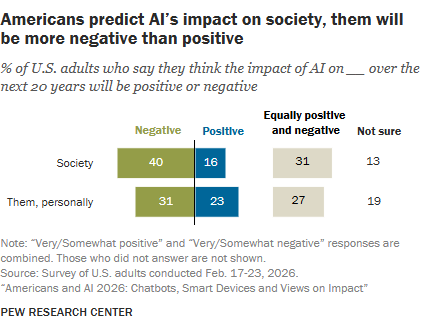
Americans are more likely to expect AI will have a negative impact than a positive one, both for society and personally.